4th Grade Frenzy: Games
Facebook Email Me Bloglovin TPT Shop Pinterest Image Map
Home About Me Shop Freebies
Showing posts with label Games. Show all posts

July 3, 2023

Fun Back to School Games

Back to School games can be a fun way to help students get to know each other and build community.  Try mixing up some printable activities with some interactive games for back-to-school fun!


1. Duck and Cover

Students form a circle. One student stands in the middle, spins around, stops, and points to a classmate saying, "Duck and cover!" The student that was pointed at ducks and covers their head. The students on either side of the student ducking try to say the other classmate's name first. The slowest to respond loses the round and goes to the middle. The student who was just in the middle takes that student's place in the circle. Begin the next round and continue as time permits. What a fun and fast-paced way to learn classmates' names!

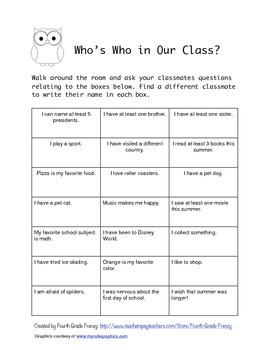
2. FREE Printable Icebreaker

This is the one where students try to find classmates who share the same interests or experiences. Grab a FREE Back-to-School Icebreaker HERE!


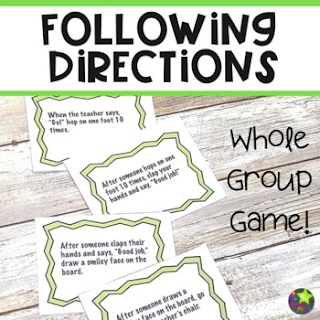
3. Following Directions Game

Students love this game! You can even time students, and have them try to beat their best score throughout the school year! 


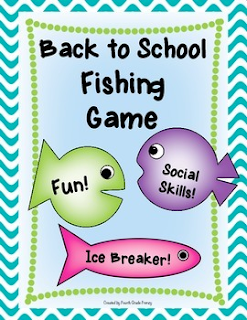
4. Fishing Game

This game helps students who are shy or introverted participate. Students fish for questions with straightforward answers.


Mix these games into your first-day (or second-day) plans and watch your class family connections form!


Make sure to have some fun yourself before you go back to school...

The Last Week of Summer

FREE Activity for new subscribers:  Sign up for the Fourth Grade Frenzy newsletter!

Click the star to follow my TpT store! 


October 9, 2022

Multiplication Facts Review Activity

 Daily multiplication fact review is easy with quick games and activities. 

This math activity works well in a small math group or can be used as a large group game.


Directions for Wash My Car!

1. Draw a large car outline on the board. 

2. Fill the car with a bunch of math facts.

3. Students line up. Each student uses an eraser to point to a multiplication fact. The student reads the math fact and states the answer. If correct, the student erases the fact and goes to the back of the line for potentially another turn. If incorrect, the student simply goes to the back of the line.

4. Continue until the car is washed!

Once students know how the activity works, draw 2 car outlines on the board, divide the class into 2 teams, and have students race to wash the cars. Use a relay race format where each team has one eraser which gets passed to the next student in line after each turn.

This activity also works well with sight words!

Need more math games and activities?

3 Fun and Easy Ways to Practice Math Facts

4 More Fun and Easy Ways to Practice Multiplication Facts

Whole Group Math Games

Students are sure to be math-motivated! 

Are you a subscriber yet?

FREE Activity for new subscribers:  Sign up for the Fourth Grade Frenzy newsletter!

Click the star to follow my TpT store! 


August 2, 2022

Whole Group Math Games

Quick whole group math games motivate students and reinforce skills that have been previously taught. Basic facts games can be easily added at the end of each lesson or in the middle of the math block as a brain break. 


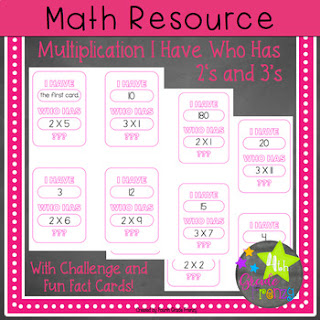
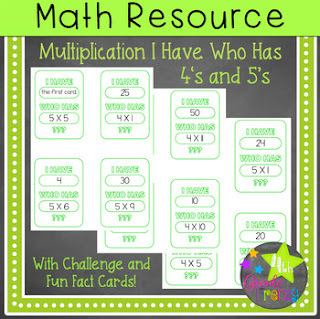
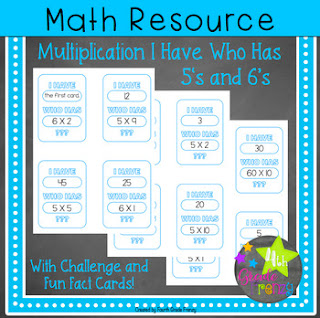
I Have Who Has type games are easy to fit in. These games begin by handing each student a game card. The student who has "I have the first card" begins the game by saying "I have the first card. Who has....(the fact on their card)" Play continues until the student with the last card says. "I have the last card." Try keeping a few sets of these cards on hand as a daily review! 


When students need a more active game, have a large beach ball prepared with lots of multiplication facts written on it with a Sharpie. Students toss the ball around and answer the fact closest to their right thumb before tossing it again.


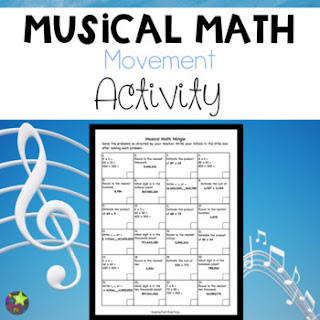
Another quick review game is Musical Math. This activity begins with a worksheet on each student's desk. Play some upbeat music as students walk or dance around the room. When you stop the music, students grab a seat and work on a worksheet. Problems can be completed in any order. Students write their initials next to each problem completed. Play the music again as a signal for students to stop working and walk or dance about again. Repeat as time permits or until students seem to be finishing up the worksheets. Musical Math can be used to review many different skills.


Need even more math games? Check out these:

5 Whole Group Games That Work With Kids At Their Seats

Math Game Time

Students are sure to love math time!

Are you a subscriber yet?

FREE Activity for new subscribers:  Sign up for the Fourth Grade Frenzy newsletter!

Click the star to follow my TpT store! 


March 18, 2021

Math Game Time

Math games can help students practice basic facts and other skills throughout the school year. Math game time can be a time set aside on a Friday or during learning stations. 


One easy game to set up during math stations or on math game day is a bump game. Bump games are easy to make, easy to set up, and easy to play!

Here is an example of an Easter theme bump game:

Materials for Bump Games:

A printable game board for each pair of students

10 - 15 chips or math cubes for each student (Partners will need different colors.)

Pair of dice

Directions for 2 Players:

Players take turns rolling the 2 dice and multiplying the numbers.

If the product is not occupied, the player places a chip on the product.

If the product is already occupied by the player's own chip, the player stacks a chip. 

If the product is occupied by the opponent's chip, the player bumps it off and replaces it with their own.

If the player rolls a product that is occupied by the opponent's stacked chips, the player loses their turn as stacked chips may not be bumped.

The player that plays all chips first is the winner!

Making a Bump Game:

Bump game boards are easy to make!

Start with a background or some graphics of the desired theme such as a holiday, space, carnival, etc. 

Create 18 spots for these numbers: 2, 4, 6, 8, 9 10, 12, 14, 15, 16, 18, 20, 24, 25, 28, 30, 32, 36

Print and play!

For a more challenging game, use 10 or 12 sided dice and adjust the products on the game board accordingly.

Pressed for time? Here is the link to the Easter Multiplication Bump Game pictured above:

Easter Multiplication Bump Game

Once students learn how to play, challenge them to create their own game board either by hand or on a computer. Give students time to partner up and try out their games! 

Are you a subscriber yet?

FREE Activity for new subscribers:  Sign up for the Fourth Grade Frenzy newsletter!

Click the star to follow my TpT store! 


August 12, 2020

5 Whole Group Games That Work With Kids At Their Seats

Kids staying at their seats may not be the ideal situation. Nevertheless, adapting temporarily can give students the opportunity to play whole group games. Of course, make sure that you are able to follow all health and safety guidelines before playing these games. 

distance-learning-games


1. Bingo

Bingo can be played to reinforce many topics from vocabulary words to math facts. Consider using printed disposable bingo boards. Students can have their own set of chips that can be stored in individual Ziploc type bags or inexpensive plastic containers. Here is a FREE blank printable bingo board that students can fill in with vocabulary words that you write on the board.


2. Twenty Objects

Display 20 pictures on the board for 1 minute. For younger students, you can start with fewer objects. The pictures can be content-related. For example, if you are studying electricity, you could have 20 pictures of items that run on electricity. To play during a math lesson, you could display 20 math-related items. After 1 minute, close the display. Students then try to write down as many items as they can remember. 


3. Unpacking Grandmother's Trunk

Students pretend to be up in Grandmother's attic unpacking an imaginary trunk. One by one, students name imaginary items that are found in the trunk. Each student must list the previous students' items before adding their own. Some like to play this game using the alphabet. A game could go like this:

Student 1: I unpacked my Grandmother's trunk and found an accordion.

Student 2: I unpacked my Grandmother's trunk and found an accordion and a bike.

Student 3: I unpacked Grandmother's trunk and found an accordion, a bike, and a cake.

Let the kids be silly and see how far they can go. If you have fewer than 26 students, they can have more than one turn. If you have more than 26 students, you can have recorders who write down what is said. Another starter for playing this game is "I am packing a suitcase for vacation and I am packing..."


4. Categories

This game is played like Scattegories. Make a list of 5 to 10 categories such as animals, plants, games, names, places, books, food, etc. Choose a random letter. Students then try to write one example from each category that begins with the selected letter. For the letter "D" a student could write:

Animal - dog

Plant - dandelion

Game - dominoes

Name - Dustin

Place - Dave and Busters

Book - The Doorbell Rang

Food - donut

Categories can be related to curriculum content once the students know how to play. For example, the solar system, rocks and minerals, music, art and design, and colonial times, could be categories. Make the categories more specific for advanced play. 


5. I Have Who Has Games

I Have Who Has is a fun game for students to play while practicing various skills. The game starts with a set of cards that are NOT numbered. All of the cards in the set are distributed even if students need to get more than one card. One student will have a card that says "I have the first card. Who has..." If students are practicing math vocabulary, the first card may read "I have the first card. Who has 2 lines on the same plane that are equal distance apart and never meet?" The student who goes next would have the card that says "I have parallel lines. Who has a part of a line that stops at given endpoints?" The game continues with students listening for clues to the card that comes next. The game ends when a student has the card that reads, "I have the last card." Students like to repeat these games while being timed to see if they can beat their previous time. During times when students cannot share materials, these games can be printed on paper and disposed of after each use. Once students can share materials, the game cards can be printed and laminated for repeated use. 


Here are a few inexpensive suggestions to get started with I Have Who Has Games:

Multiplication Game 2's and 3's

Multiplication Game 3's and 4's

Multiplication Game 4's and 5's

Multiplication Game 5's and 6's


Dreaming of getting back to the future with all the things? Here are some not-so-socially-distanced games to keep in mind for later on:

Whole Group Games


Are you a subscriber yet?

FREE Activity for new subscribers:  Sign up for the Fourth Grade Frenzy newsletter!

Click the star to follow my TpT store! 


March 19, 2018

3 Whole Group Games

whole-group-games


Have you ever planned a lesson with the best technology integration only to have the technology fail as you begin the lesson?  My favorite technology fail story to tell about is the time I was teaching math. I was writing the word "associative" when the Smartboard froze immediately after a particular letter...I'll let you figure out which letter that was! Can you hear those 4th Graders giggling? Anyway....it may be a good idea to have a few games up your sleeve for those times when technology doesn't work or simply when the kids need to get up and move. At other times, you may want to have your kiddos practice some social skills! Here are a few games that require no prep and can be used with multiple levels simply by differentiating your questioning.


7 Up with a Twist

(for any content other than long math problems)

Choose 7 students to go to the front of the room. The remaining students place their heads down on their desks and their thumbs up. The 7 students silently walk around the room and push down a thumb of one of their classmates and return to the front of the room. When all 7 students are back to the front of the room, say "Wake up sleepy heads!" The students who have their thumbs pushed down, stand up. The teacher asks each of the 7 chosen students to answer review questions one at a time. If the student gets the answer right, they get to guess a classmate who may have pushed down their thumb. If the student guesses the classmate correctly, the guesser and thumb pusher trade places.  If the guesser does not correctly answer the review question, he/she sits back down. You can differentiate your questioning based on the needs of your students. Repeat the process as time allows.


Sink or Swim

(for any content other than long math problems)

Split the class in half, and have students face each other on opposite sides of the room. (If you assign your kiddos numbers, you could have evens on one side and odds on the other.) Pose a question to the first member of the first team. If the student answers correctly, he/she gets to sink someone on the opposing team. When sunk, the student sits down. If the student answers their question incorrectly, he/she is sunk and must sit down. Next, pose a question to the first student on the opposing team. If the student is correct, he/she may opt to save a kid on his/her own team, and that student would rejoin the team. Another option for a correct answer is to sink someone on the opposing team. I like to add a rule that a student can only be sunk once until every member of a team has been sunk once, and then everyone is fair game again. Play continues in this manner until one team is completely sunk. The team with members standing wins!


4 in a Row with a Twist

(for vocabulary in any content area)

Write 16+ words on the board from the content being reviewed. Students copy the vocab words in random boxes on their 4 in a Row board. They may not use a word more than once. (Blank board FREE for you below!) Need the game, but forgot to print? No worries, simply have your kiddos fold a blank sheet of paper until they have 16 boxes. Then they can trace over the fold lines and add words in the boxes. While students are preparing their boards, prepare prizes. Prizes for 4 in a row get written individually on sticky notes. Try starting with about 5 low cost or no cost prizes such as erasers, pencils, drawing time, etc. For a twist, add in gag prizes such as pencil shavings, a plastic spoon, etc. Kids love to hear the prize to see if it is real or fake as they call the gag prizes. So many laughs! Pile up the sticky notes listing each prize and keep them up-side-down. Hand out chips, and play. Teacher reads the definition of each review word. Students cover each word that they have on their board. For an added twist, instead of yelling, "Bingo," have students perform an action such as pretend to shoot a basketball, call out something funny such as "Can you tell me how to get to Sesame Street!?", or sing a few lines of a song such as Let is Go.....when they win. Then have each winner call out their winning words. All winners for the round come up to the teacher where the prize is revealed to students from the first sticky note.  Students remove chips from game boards and play again. Continue until you have distributed all of the prizes or run out of time.

Get your FREE blank 4 in a Row board HERE!


Consider writing down these 3 games on an index card for those times when your lesson includes technology that just won't cooperate or you and your kiddos just need to interact!

Are you a subscriber yet?

FREE Activity for new subscribers:  Sign up for the Fourth Grade Frenzy newsletter!

March 17, 2016

Cup Stacking Games


math-game


Cup stacking is a fun activity that can be used to review a variety of skills. Students respond to a question, state the answer to a fact, or read the word on each cup before stacking. Partners can help each other stay on task, check for correct responses, or even time each other. Set up several cup stations around the room, and have students rotate through the different stations. Falling plastic cups may get a bit noisy, so try stacking them on the carpet. For rooms that are not carpeted, try asking your local carpet retailer for samples. My local store saved me a colorful bunch of carpet mats. Paper cups may be somewhat less noisy and can be a great alternative.

Here are some ideas for what to write on cups for use in review stations:

1. Sight words or high-frequency words
2. Numbers
3. Addition, subtraction, multiplication, or division facts
4. Short answer review questions for science or social studies
5. Definitions of vocabulary words

Already using cup stacking in your room? Try a fun alternative. Add some fun questions to each set! Kids love it when they get to these unrelated, just-for-fun questions such as Favorite color? Favorite subject? Birthday? Number of siblings? BFF?


Here is a stack that I made for basic facts with some fun questions mixed in:


math-game

math-gamemath-game

Are you a subscriber yet?

FREE Activity for new subscribers:  Sign up for the Fourth Grade Frenzy newsletter!

Click the star to follow my TpT store!