4th Grade Frenzy: Math
Facebook Email Me Bloglovin TPT Shop Pinterest Image Map
Home About Me Shop Freebies
Showing posts with label Math. Show all posts

November 17, 2024

Mastering Multiplication Facts with Multiples: A Practical Classroom Strategy

Multiplication facts are foundational to many math concepts, yet they often challenge students. To ease the learning curve and create meaningful connections, teaching multiples is an excellent strategy. By focusing on patterns and relationships, students can better understand multiplication as a concept and memorize their facts more effectively. Let’s explore why multiples work and how you can incorporate them into your teaching.


Why Focus on Multiples?

Multiples are the products of a number multiplied by whole numbers (e.g., the multiples of 4 are 4, 8, 12, 16, and so on). By working with multiples, students begin to see multiplication as a series of additions or a pattern that repeats predictably. This method is highly effective because:

  • It emphasizes patterns: Multiples reveal consistent, repeating structures that make learning multiplication more intuitive.
  • It connects concepts: Students see multiplication as a form of skip counting, making it easier to grasp.
  • It builds fluency: Regular practice with multiples helps students recall facts faster.

  • Activities to Teach Multiples and Multiplication Facts

    Here are some practical and engaging activities for your classroom:

    1. Skip Counting Chains

    • What to do: Provide a visual by having students create paper chains with each link representing a multiple of a number. For example, a "3 chain" might include links labeled 3, 6, 9, 12, etc.
    • Why it works: This hands-on activity reinforces the idea that multiplication involves repeated addition.

    2. Multiples Hopscotch

    • What to do: Create a hopscotch board where each square represents a multiple of a target number. For example, for the number 5, the squares might read 5, 10, 15, etc. Students hop through the board while reciting the multiples aloud.
    • Why it works: Movement activates kinesthetic learning, making it easier for students to memorize facts.

    3. Multiples on a Number Line

    • What to do: Draw a large number line on the board. Have students place magnets or sticky notes at the multiples of a chosen number.
    • Why it works: This visual strategy demonstrates spacing and helps students see how multiples fit into a sequence.

    Integrating Multiples into Daily Practice

    Repetition is the key to mastery, so make practice a regular part of your routine. Incorporate these strategies into math centers, warm-up activities, or brain breaks. For example:

    • Morning Multiples: Begin the day by skip-counting aloud as a class.
    • Multiples Challenge: Give students a number and see how many multiples they can write in 60 seconds.
    • Exit Tickets: Before leaving, ask students for the next multiple of a number you call out.
    • Learning Station Games and Activities such as


    Using multiples to reinforce multiplication facts goes beyond memorization—students build connections, spot patterns, and truly understand the concept of multiplication. Whether through games, visuals, or movement, multiples make math meaningful and fun.

    Looking for more multiplication fact ideas? Check out these ideas:

    4 More Fun and Easy Ways to Practice Multiplication Facts

    With faith and friendship,

    September 12, 2024

    Robot Activities for Elementary Students

    As teachers, we are always looking for ways to bring stories to life and engage our students in creative, hands-on learning. The Wild Robot by Peter Brown is a beloved novel that blends themes of nature, survival, and technology through the journey of Roz, a robot stranded in the wild. With the release of The Wild Robot movie, now is the perfect time to incorporate robot-themed activities that deepen students' understanding and enhance their connection to the story.

    Here are four robot-themed activities designed to complement the book and/or movie and spark your students' imaginations.

    1. Build a Survival Robot

    In The Wild Robot, Roz must learn how to survive in the wilderness. Challenge your students to design and build their own "survival robot" using recycled materials like cardboard, foil, and plastic containers. Have students think about the types of features their robot would need to survive in different environments, such as a forest, desert, or ocean.

    2. Create a Nature Journal

    In The Wild Robot, Roz learns from the animals and the environment around her. To reflect this, students can create their own nature journals as if they were robots like Roz. Take students outside to observe their surroundings, and have them document their observations in a journal using descriptive language and sketches.

    3. Robot Emotions Writing Task

    One of the key themes of The Wild Robot is Roz learning about emotions and forming relationships with the animals. In this writing activity, ask students to imagine how a robot might express or understand emotions like fear, happiness, or sadness.

    Have students write a short story or diary entry from the perspective of a robot who is experiencing emotions for the first time. Encourage them to be creative, thinking about how a robot might explain feelings in logical or mechanical terms.

    4. Robot Themed Lessons

    Have students build this robot to learn about math functions. What a fun way to practice math!

    Math Functions Robot Activity


    By incorporating these robot-themed activities into your lessons, you can spark your students' creativity and critical thinking. These activities not only complement the movie’s themes of nature and technology but also allow your students to immerse themselves in hands-on projects that connect literature with real-world learning.

    Have fun bringing Roz’s world to life in your classroom—and watch your students’ imaginations take flight!

    Are you a subscriber yet?

    FREE Activity for new subscribers:  Sign up for the Fourth Grade Frenzy newsletter!

    Click the star to follow my TpT store! 


    With faith and friendship,

    April 5, 2024

    How to Integrate Music Into Your Math Lessons

    Need to capture your students' attention? Try enhancing your lessons with music! Music stimulates various parts of the brain making it a great tool for education.


    1. Play Classical Music During Arrival and Dismissal

    Create a playlist of classical music as students enter the classroom. Classical music could lead to a calm dismissal too!

    2. Make Math Chants

    Encourage students to make up rhythmic math chants for multiplication facts. Have them work in small groups and share with the class.

    3. Create Word Problems

    Using popular songs or artists, have each student create a word problem for classmates to solve. Include guidelines in your directions such as numbers must be 2 or 3 digits, no zeros, etc. Students can write their problems on an index card and trade cards with a partner and solve them.

    4. Math Rock Bands

    Divide students into groups. Each group creates a song or rap about a math concept. Hold a Math Rock Band concert!

    5. Musical Math

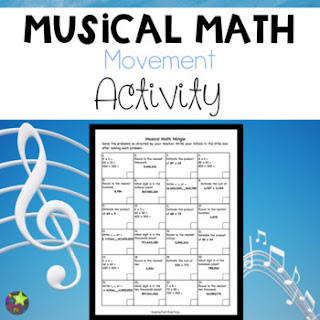
    Prepare a review worksheet. Place a worksheet on each student's desk. Play some music. While the music plays, students move and dance about the room. Pause the music and students stop and work on the problems at any desk. Start the music back up and students move and dance again. Repeat until the worksheets are complete. Go over the answers.

    Try this place value review worksheet for only $1.25:


    Integrating music into math lessons can improve engagement and retention!

    With faith and friendship,

    September 6, 2023

    Math Motivation with Food

    If you find your students (and you!) getting a little bored with the math curriculum, try adding food to your lessons.


    1. Appetizing Assignments

    Grab some snacks and lots of math problems. The problems could come from students' math books, task cards, or worksheets.  Assign a $ value to each math problem. Then assign a $ amount to the snacks, and put them on display. Students solve problems correctly in order to get enough $ to buy the desired snack. 

    Possibilities for distributing the problems:

    • Use premade worksheets and write the value on each problem before copying the pages for the class.
    • Label bins or bags with $ values.Write problems and their values on 3X5 index cards. Add the completed index cards to the appropriate bins. Students select one problem at a time to solve.
    • Use task cards you already have on hand. A wipe-off marker or removable sticker can be used to assign values to the problems.

    2. (X, Y) Marks the Spot


    *This game is for classrooms with square tile floors that can be used as coordinates.

    While students are at recess or special, hide several snacks at various coordinates throughout the room. Mark the coordinate (0, 0) with tape, chalk, or an erasable marker.

    Write various coordinates on 3 X 5 index cards and place them in a bin. When students return, they each select a card. One at a time, they stand on (0, 0) and proceed to the coordinates on their card. If a snack is found, the student takes it and goes to the end of the line. If there is no snack, the student just returns to the end of the line to try again. Continue as time allows or until cards run out. 

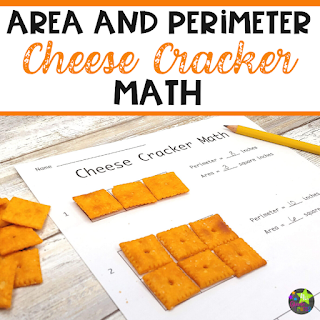
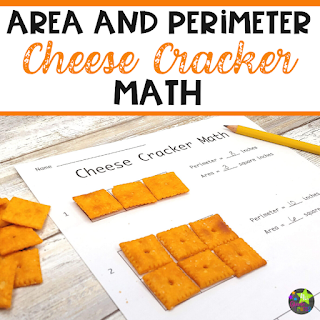
    3. Cheese Cracker Math


    This area and perimeter activity can quickly and easily be added to your lessons: 


    ★★★★★ Extremely Satisfied
    Jenneane says, "I can't say enough about this resource! My students love any opportunity to work with food!

    More Math!
     
    Students are sure to be motivated for math! 

    FREE Activity for new subscribers:  Sign up for the Fourth Grade Frenzy newsletter!

    Click the star to follow my TpT store! 

    With faith and friendship,


    May 5, 2023

    100% Fun, 100% Educational: 3 End of School Year Math Games for Kids

    Kids need a break from traditional math lessons as the end of the school year winds down. These math games are the perfect way to spice up the last few weeks of school by reviewing math concepts and having fun.


    1. Math Bingo

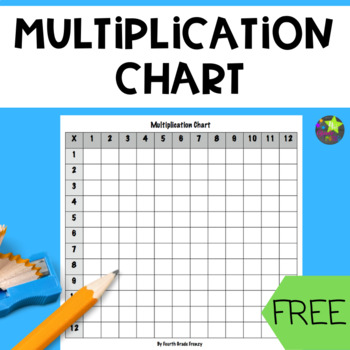
    Start by having students complete this FREE multiplication chart: 


    Students then fold a blank piece of paper 4 times, unfold it, and trace over the fold lines. Using the multiplication chart, students fill in the 16 boxes with different products. Each product can only be used one time unless it appears on the chart more than once such as 24. Distribute bingo chips and begin play by calling out any multiplication problem on the chart. Students cover the product if they have it. The teacher can keep track of the facts called by crossing out the products as they are used. The first student to get 4 in a row wins! 


    2. Math Scavenger Hunt

    Write math problems on index cards and hide the cards around the classroom or outside. Pair students up and give them clues as to where to find each math problem. Students must solve each problem before trying to find the next one. The group that finishes first with correct answers wins!


    3. Math Relay Race

    Divide the class into 4 teams and have students form 4 lines outside. Divide a set of multiplication fact flashcards into sets of 4 and place them ahead so that students will run and pick one up. At your signal, the first student on each team runs, grabs a flash card, and brings it back to the next student in line to answer. When the correct answer is given, that student runs to the stack of flashcards, grabs one, and runs back to their team line. The teacher should supervise the lines to make sure the problems are being answered correctly. When an entire team finishes, that group sits down silently. The team that finishes and sits first wins!


    Students will better understand math concepts and be better prepared for next year. Get ready for some math-filled fun!

    Check out some more math games that your class will love to play!

    Whole Group Math Games

    Multiplication Facts Review Activity

    FREE Activity for new subscribers:  Sign up for the Fourth Grade Frenzy newsletter!

    Click the star to follow my TpT store! 


    March 22, 2023

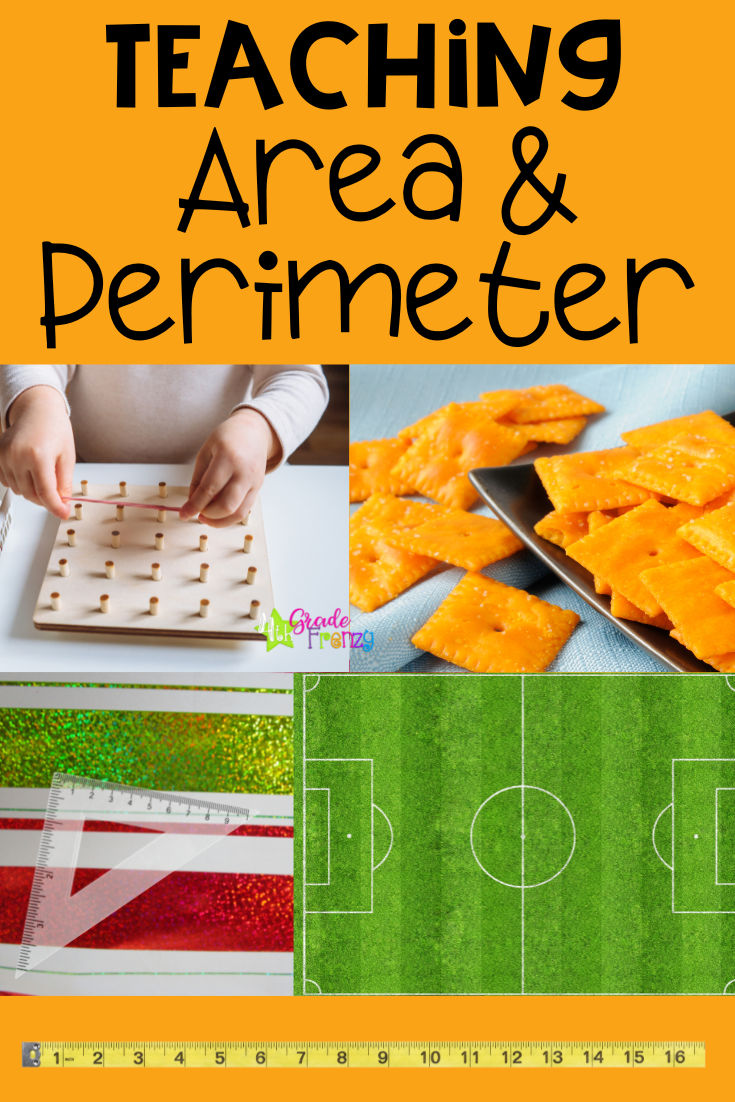
    5 Ways to Teach Area and Perimeter

     Teaching area and perimeter can be both challenging and fun.


    1. Start with real-world examples.

    Students will see that it's practical to learn how to calculate area and perimeter if you use examples that are meaningful such as a soccer field, garden, or the classroom.

    2. Get out the geoboards.

    Have students make a rectangle and trade their board with a partner. Each student figures out the area and perimeter of their partner's board. Extend this activity by playing Quiz Quiz Trade with the boards.

    3. Practice.

    Provide students with worksheets for morning work and task cards during math stations. Use shapes made out of colorful wrapping paper or leftover scrapbook paper.

    4. Use cheese crackers.

    Students love this activity:


    5. Design figures of a particular area and perimeter.

    If you have 12 inch tile floors, students can work in pairs to make figures using some painter's tape. For example, have students create a figure that has a perimeter of 8 feet. Then have them find the area. On a smaller scale, use graph paper.

    You may also like ideas about: 

    Teaching Multiplication Facts


    FREE Activity for new subscribers:  Sign up for the Fourth Grade Frenzy newsletter!

    Click the star to follow my TpT store! 


    October 9, 2022

    Multiplication Facts Review Activity

     Daily multiplication fact review is easy with quick games and activities. 

    This math activity works well in a small math group or can be used as a large group game.


    Directions for Wash My Car!

    1. Draw a large car outline on the board. 

    2. Fill the car with a bunch of math facts.

    3. Students line up. Each student uses an eraser to point to a multiplication fact. The student reads the math fact and states the answer. If correct, the student erases the fact and goes to the back of the line for potentially another turn. If incorrect, the student simply goes to the back of the line.

    4. Continue until the car is washed!

    Once students know how the activity works, draw 2 car outlines on the board, divide the class into 2 teams, and have students race to wash the cars. Use a relay race format where each team has one eraser which gets passed to the next student in line after each turn.

    This activity also works well with sight words!

    Need more math games and activities?

    3 Fun and Easy Ways to Practice Math Facts

    4 More Fun and Easy Ways to Practice Multiplication Facts

    Whole Group Math Games

    Students are sure to be math-motivated! 

    Are you a subscriber yet?

    FREE Activity for new subscribers:  Sign up for the Fourth Grade Frenzy newsletter!

    Click the star to follow my TpT store! 


    August 2, 2022

    Whole Group Math Games

    Quick whole group math games motivate students and reinforce skills that have been previously taught. Basic facts games can be easily added at the end of each lesson or in the middle of the math block as a brain break. 


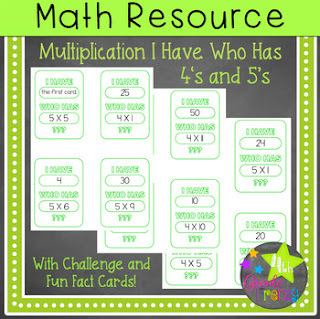
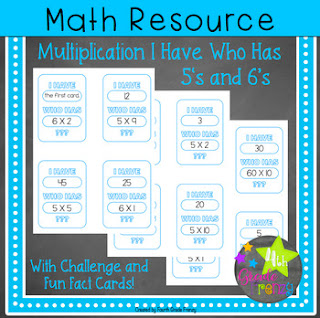
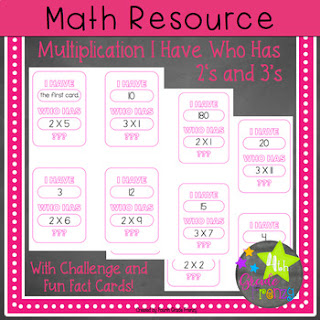
    I Have Who Has type games are easy to fit in. These games begin by handing each student a game card. The student who has "I have the first card" begins the game by saying "I have the first card. Who has....(the fact on their card)" Play continues until the student with the last card says. "I have the last card." Try keeping a few sets of these cards on hand as a daily review! 


    When students need a more active game, have a large beach ball prepared with lots of multiplication facts written on it with a Sharpie. Students toss the ball around and answer the fact closest to their right thumb before tossing it again.


    Another quick review game is Musical Math. This activity begins with a worksheet on each student's desk. Play some upbeat music as students walk or dance around the room. When you stop the music, students grab a seat and work on a worksheet. Problems can be completed in any order. Students write their initials next to each problem completed. Play the music again as a signal for students to stop working and walk or dance about again. Repeat as time permits or until students seem to be finishing up the worksheets. Musical Math can be used to review many different skills.


    Need even more math games? Check out these:

    5 Whole Group Games That Work With Kids At Their Seats

    Math Game Time

    Students are sure to love math time!

    Are you a subscriber yet?

    FREE Activity for new subscribers:  Sign up for the Fourth Grade Frenzy newsletter!

    Click the star to follow my TpT store! 


    March 18, 2021

    Math Game Time

    Math games can help students practice basic facts and other skills throughout the school year. Math game time can be a time set aside on a Friday or during learning stations. 


    One easy game to set up during math stations or on math game day is a bump game. Bump games are easy to make, easy to set up, and easy to play!

    Here is an example of an Easter theme bump game:

    Materials for Bump Games:

    A printable game board for each pair of students

    10 - 15 chips or math cubes for each student (Partners will need different colors.)

    Pair of dice

    Directions for 2 Players:

    Players take turns rolling the 2 dice and multiplying the numbers.

    If the product is not occupied, the player places a chip on the product.

    If the product is already occupied by the player's own chip, the player stacks a chip. 

    If the product is occupied by the opponent's chip, the player bumps it off and replaces it with their own.

    If the player rolls a product that is occupied by the opponent's stacked chips, the player loses their turn as stacked chips may not be bumped.

    The player that plays all chips first is the winner!

    Making a Bump Game:

    Bump game boards are easy to make!

    Start with a background or some graphics of the desired theme such as a holiday, space, carnival, etc. 

    Create 18 spots for these numbers: 2, 4, 6, 8, 9 10, 12, 14, 15, 16, 18, 20, 24, 25, 28, 30, 32, 36

    Print and play!

    For a more challenging game, use 10 or 12 sided dice and adjust the products on the game board accordingly.

    Pressed for time? Here is the link to the Easter Multiplication Bump Game pictured above:

    Easter Multiplication Bump Game

    Once students learn how to play, challenge them to create their own game board either by hand or on a computer. Give students time to partner up and try out their games! 

    Are you a subscriber yet?

    FREE Activity for new subscribers:  Sign up for the Fourth Grade Frenzy newsletter!

    Click the star to follow my TpT store! 


    January 19, 2021

    Teaching Long Division

    Teaching long division requires patience and practice! The following steps take students from the concrete to the abstract so they have an understanding of what long division actually is.

    long-division-worksheets

    Step 1

    Step one involves manipulatives to remind students that division is actually just making groups. I'm partial to Skittles, but other options could be: fish crackers, mini-pretzels, small crackers, etc.

    long-division-worksheets

    Step 2

    For Step 2, explain to students that it wouldn't be practical to sort items into groups when dealing with larger numbers, but base 10 blocks will help them visualize the division. 

    long-division

    Step 3

    For Step 3, use the same problem that was used in step 2 to introduce the algorithm.

    long-division

    Step 4

    For Step 4, continue working through a few problems together, increasing difficulty based on students' needs.

    long-division

    Step 5

    When students are ready, show them how to check their answer with multiplication. Then, practice, practice, practice! Since some students get overwhelmed by a page filled with problems, consider having students work through one long division problem per day until confidence builds. 

    long-division


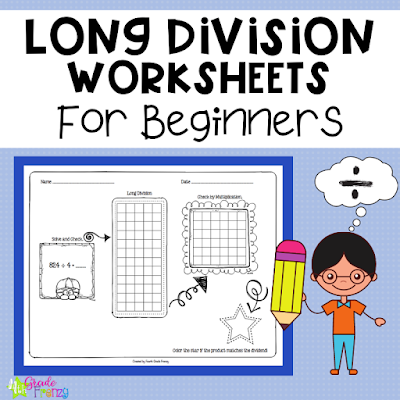
    Here you'll find a set of 15 worksheets where students complete one long-division problem per day. It's a great way to get students comfortable with long division!
    long-division-worksheets


    Are you a subscriber yet?

    FREE Activity for new subscribers:  Sign up for the Fourth Grade Frenzy newsletter!

    Click the star to follow my TpT store! 


    June 6, 2020

    Make Math Practice a Habit

    In his book, Outliers, Malcolm Gladwell refers to the 10,000-hour rule. This rule implies that it takes roughly 10,000 hours of practice to become an expert at anything. Although there are critics, most would agree that if we look closely at experts in many fields, we will find the stepping stones along the way in the form of significant units of time spent practicing.

    4th-grade-math

    For students, practicing math daily can help with the retention of foundation skills even as new skills are introduced. In particular, many students seem to need significant practice with addition, subtraction, multiplication, and division algorithms. Practice can be assigned for morning work, warm-ups, take-home practice, distance learning packets, tutoring, or extra help.

    Practice can take the form of copying problems off the board into a notebook, worksheets, or digital practice. Copying problems off the board will help with eye-hand coordination. Worksheets can save teachers time and offer an answer key. Finally, there are plenty of websites that offer quick practice in the form of games and interactive learning.

    If you have students practice by copying a few problems off the board or by solving problems on worksheets each day, you could give students time to explain how several problems are solved. The process of explaining will further help students retain how to complete the algorithms. It is important that students who are struggling and more confident students be allowed to explain how to solve the problems. Of course, the teacher would support struggling students to be sure they were confident enough to present a solution to the class.

    These 3 printable resources each provide 20 days of practice. With these worksheets, students solve just 4 problems each day, and there is plenty of space to show work. The worksheets can be alternated with writing problems on the board and digital practice for variety.
    Math Practice

    Daily Math Practice Fall Theme
    Daily Math Practice Winter Theme
    Daily Math Practice Spring Theme

    Are you a subscriber yet?

    FREE Activity for new subscribers:  Sign up for the Fourth Grade Frenzy newsletter!

    Click the star to follow my TpT store! 


    March 7, 2020

    5 Easy Ways To Celebrate Pi Day In The Elementary Grades

    Why celebrate Pi Day? Because it's fun, educational, and why should the big kids have all the fun?!
    pi-day

    In case it's been a while since you came across the word, Pi is the ratio of a circle's circumference to its diameter. Pi is an irrational number, which means its decimal form never ends or becomes repetitive. March 14th is Pi Day because the date contains the first 3 digits of Pi: 3.14. Back in the day, Pi was just another math term to learn. Nowadays, classrooms all over the world celebrate Pi Day in many creative ways. Kids today have all the fun!

    Students in 4th Grade can begin to understand Pi! Here are just a few ideas to try:

    1. Read Circumference and the Dragon of Pi 

    Circumference and the Dragon of Pi is written by Cindy Neuschwander, and illustrated by Wayne Geehan. It is a good introduction and includes plenty of math terms. It may go over some heads a bit, but it's a fairy tale, and that is an overlooked genre. So give it a go.

    2. Challenge students to memorize as many digits of Pi as they can. 

    I once had a student who memorized over 30 digits! Make the competition sweet with a Tastykake pie for a prize!

    3. Get out the calculators and rulers and find the circumference of some circles. 

    Find some circular objects in the classroom, complete an example together, and let students try out the formula with a partner. Measure the diameter of a circle and multiply by (Pi) 3.14 to find the circumference. Make sure the kiddos know that the circumference is approximate when multiplying the diameter times 3.14!

    4. Use this lesson to make Pi posters to take home.

    Pi Day Lesson

    5. Finish up by making individual Pies! 

    I grab those mini pie crusts and individual puddings on sale. Students spoon the pudding into the crusts with a plastic spoon and enjoy some mini pies on Pi Day!


    How will you celebrate Pi Day in your classroom? 

    Are you a subscriber yet?

    FREE Activity for new subscribers:  Sign up for the Fourth Grade Frenzy newsletter!

    Click the star to follow my TpT store  

    February 23, 2020

    Fractions In Real Life

    Fractions can be a difficult concept for some students. However, when we begin with a concrete and relatable topic for our lesson, students are given the foundation for further learning.

    fractions-4th-grade

    My absolute favorite way to teach and explore fractions is to make slime with the kids! At the end of the school year, many kids say making slime is their favorite activity of the year. Allow me to share how we make slime while learning fractions!

    Prepare For The Lesson


    1. Choose The Recipe.

    Keep student allergies in mind, and be choose a recipe with safe ingredients.
    The recipe I have had success with is listed below.

    2. Gather Up Materials.

    For the recipe below you will need:
    white school glue (one-fourth cup per student)
    baking soda (a three-fourth teaspoon per student)
    food coloring
    contact lens solution (1.5 teaspoons per student)
    plastic bowls
    craft sticks for stirring
    wax paper
    measuring cup (one-fourth)
    measuring spoons (one teaspoon, one-half teaspoon, three-fourth teaspoon)

    I use 2 days to complete the slime activity.

    Slime Making Day One


    1. Post The Recipe.

    I post this recipe on the board:

    4 oz (one-half cup) white school glue
    1.5 teaspoons baking soda
    6 - 8 drops food coloring
    3 teaspoons contact lens solution

    I explain that the recipe would make enough for 2 kids, but I want each student to be able to make their own slime. "Hmmm, how can we work this out?" Some of your students are bound to come up with halving the recipe.

    2. Do Some Math.

    We then take the time to do the math of halving each ingredient.

    Here is the recipe that we end up with:

    2 oz (one-fourth cup) white school glue (We use Elmers.)
    3/4 (three-fourths) teaspoon baking soda
    3 - 4 drops of food coloring
    1.5 (one and one half) teaspoon contact lens solution

    We then go over the vocabulary word knead. Demonstrate with playdough or show a visual of dough being kneaded.

    Slime Making Day 2


    1. Set Up The Materials Prior To The Lesson.

    It may help to measure out the glue in advance using small plastic cups. This can be done by pouring 2 ounces (one-fourth cup) of water into one cup, making a line where it stops with a sharpie, and marking the same spot on all the other cups. The lines show where to fill with glue. This way the glue can be poured up to the line without having to use a measuring cup every time.


    Using a table, line up the materials like a buffet station. Students will be forming a line and taking a plastic bowl, pouring the glue, taking a popsicle (craft) stick to stir, adding baking soda, adding food coloring, and adding contact lens solution.

    2. Set Expectations Rules And Give Directions.


    3. Have Fun Making The Slime!


    Students line up at the table forming an assembly line and follow these steps:

    -Take a plastic bowl and the pre-measured one-fourth cup of glue.
    -Pour the glue into the bowl. Discard the empty cup.
    -Add 3/4 (three-fourths) teaspoon baking soda to the glue and stir with a craft stick.
    -Add 3 - 4 drops of food coloring and stir again
    -Add 1.5 (one and one-half) teaspoon contact lens solution. Stir until slime forms.
    (Additional contact lens solution can be added a drop at a time if consistency is too sticky.)
    -Knead on wax paper.
    -Play with slime!
    -Store in plastic Easter Eggs or container of choice.

    Give students time to reflect on the lesson. Remind students to follow the rules of their parents/guardians for playing with slime at home and to keep it away from babies, small children, and pets!


    *Note: students often ask for a copy of the slime recipe!

    Extend your study of fractions with this fun printable fraction activity to reinforce multiplying fractions by whole numbers.

    multiplying-fractions


    What creative ways have you taught fractions in your class? 

    Are you a subscriber yet?

    FREE Activity for new subscribers:  Sign up for the Fourth Grade Frenzy newsletter!

    Click the star to follow my TpT store!